The Wellness Journal
Per serve or per 100g? How to compare Australian food labels
Published 14 November 2026
Wellness n Co JournalUse the per 100g column to compare similar foods, or per 100mL for drinks. Then use the serving information to work out what is in the amount you actually eat or drink. The two columns answer different questions. A smaller number per serving does not necessarily mean a product contains less of that nutrient for the same quantity.
For a Sydney shopper comparing two breakfast cereals or supermarket drinks, that distinction is more useful than a claim on the front of a packet. You do not need to memorise every nutrient target. Start by comparing equal quantities, then check your portion and the rest of the label.
What the two columns tell you
A nutrition information panel reports average amounts. The food business chooses its labelled serving size, so two brands can use different serves. The per 100g or per 100mL column gives you a common basis for comparison. These are features of the Australian labelling system, not a personalised meal plan. Food Standards Australia New Zealand explains the panel and its columns.
“Per serving” means the amount in the serve named on that label. It does not automatically mean one packet, one bowl or the amount you should eat. Read the serving size and servings per package together before using that number.
A cereal example: the smaller number can mislead
Imagine two fictional cereals. These are arithmetic examples, not real products or recommended choices:
- Cereal A lists a 30g serve with 3g of sugars, and 10g of sugars per 100g.
- Cereal B lists a 45g serve with 3.6g of sugars, and 8g of sugars per 100g.
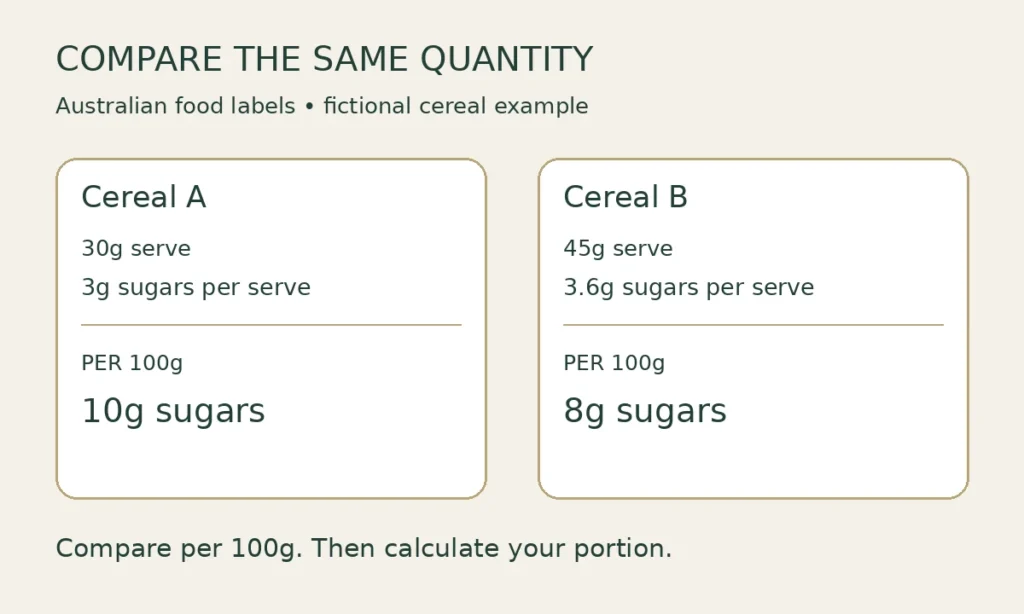
Looking only at the serving column, A appears lower: 3g versus 3.6g. But A's labelled serve is smaller. For the same 100g quantity, B contains less sugar. If you pour 60g, A provides 6g of sugars and B provides 4.8g.
That calculation does not establish which cereal is the better overall choice. It answers one narrow question about sugar at equal quantities. Compare other relevant information too, rather than letting one number decide for you. NSW Government guidance explains that the sugars figure includes both naturally occurring and added sugars; the ingredients list provides additional context. Read the NSW food-label guide.
Work out the amount in your portion
The basic calculation is:
Nutrient in your portion = amount per 100g × portion in grams ÷ 100.
For liquids labelled per 100mL, use your portion in millilitres instead. Keep the nutrient unit unchanged. If the label gives sodium in milligrams, the answer is milligrams; if it gives protein in grams, the answer is grams.
Suppose a fictional yoghurt lists 6g of protein per 100g. A 170g portion contains approximately 6 × 170 ÷ 100 = 10.2g of protein. If you eat 85g, the same calculation gives 5.1g. These are estimates from the label's average values, not laboratory measurements of your particular spoonful.
You can also multiply the per-serving amount by the number of labelled servings you consume. Use whichever route is clearer, but do not mix the per-serving figure with the per-100g formula.
A bottle is not always one labelled serve
Consider a fictional 500mL drink with a labelled serving size of 250mL and 5g of sugars per 100mL. One labelled serve contains 12.5g. The whole bottle contains 25g. If you drink the whole bottle, recording the serving figure alone would miss half the amount.
Before doing the maths, check whether the panel describes the product as sold or after preparation. Powder, concentrate and prepared drinks can have different quantities. Read the preparation directions and any panel qualifications; do not apply a dry-powder figure directly to a finished drink's volume.
Compare similar foods, not unrelated categories
A cereal-to-cereal comparison is more useful than comparing cereal with milk simply because both have a panel. Healthdirect recommends checking the per 100g or per 100mL column when comparing similar products. Its guidance also notes that many nutritious unpackaged foods do not have a nutrition panel. See Healthdirect's food-label explanation.
Likewise, a nutrient missing from a panel is not proof that the food contains none. FSANZ explains that fibre does not always have to appear. Do not fill an unknown value with zero in a tracker or comparison spreadsheet.
Check beyond the nutrition numbers
The ingredients list and allergy information answer questions that a nutrient total cannot. NSW Food Authority explains that ingredients are listed in descending order by their weight when added. Its ingredients and nutrition guide is a useful next step when a front-of-pack claim leaves you unsure.
This article is about packaged food labels, not medicine doses. Vitamin supplement packaging uses different information, including AUST numbers where applicable. Our separate Australian supplement-label guide explains that distinction. If you are collecting product information for a clinical discussion, our medicines-list checklist explains what to bring rather than guessing from memory.
A quick routine at the shelf
Start with two similar products. Check that both figures use the same basis, compare the nutrients relevant to your question, and then calculate your actual portion. Finally, read the ingredients, allergy information and preparation instructions. Save a photo of the current label if you need to check it later; recipes and packaging can change.
If you have a condition requiring a specific eating plan, ask your treating clinician or dietitian how to interpret the label for that plan. This guide teaches comparison and arithmetic, not an individual nutrient target, diagnosis or treatment recommendation.